About Cappadocia
Visit our
gallery !
The ancient region of Cappadocia lies in central
Anatolia, between the cities of Nevsehir, Kayseri and Nigde.
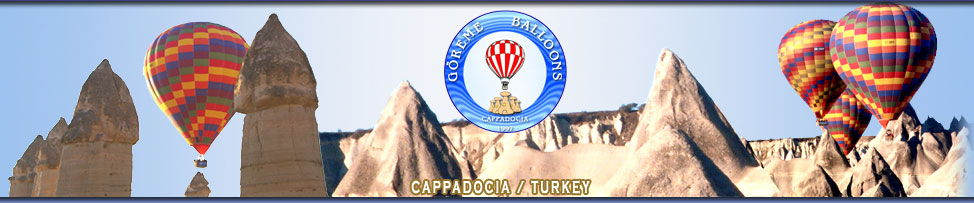
Here, the traveller finds one of the most fantastic
landscapes in the world. Three million years ago, violent
eruptions of the volcanoes Mt. Erciyes (3891m) and Mt. Hasan
(3250m) covered the surrounding plateau with tuff. Wind and
weather have eroded the soft volcanic rock into hundreds of
strangely shaped pillars, cones and "fairy chimneys", often
very tall, and in every shade from pink through yellow to
russet browns.
Since the most ancient of times, men have hollowed out
troglodyte dwellings in this soft rock, and here, at the
dawn of Christianity, the early Christians made countless
cave churches, chapels and monasteries. There are over 600
churches scattered through the valleys. The art style of the
churches falles into two categories: the 8th and 9th
centuries are the iconoclastic years, with decorations in
red earth tones and symbolism in simple geometric motifs;
the 10th to the 13th centuries saw decorations on a plaster
base and show the lives of Christ and various saints.
Interestingly, in some of the churches the frescoes of the
later period have fallen off, revealing earlier decorations
underneath. The architectural plan of the churches is
uncomplicated.
Also in this region are a number of underground cities which
were used by Christians as places to retreat to and live in
until danger from their enemies had passed. These cities
were well-hidden and safe. There were rooms for grain
storage, stables, sleeping chambers, kitchens and air
shafts. Today they are well-lit and would be an interesting
part of your tour.
Goreme is an important area for shopping with its wonderful
carpets and kilims, onyx souvenirs, and very fine local
wines. It is also a wonderful region for trekking and for
photo-safaris. The scenery is breathtaking in all four
seasons: miniature poppies in the springtime, the touring
hot-air balloons and flowers of summertime, autumn's grapes
and blaze of gold, and the winter blanket of snow.
|